Haiti’s Development Work streams
Haiti's challenges are myriad, and it can be tough to know where to start. At StimPack, we have found it useful to break down these issues into a clear framework of effort categories, along with our assessment of where we stand today.
However, the greatest value of this exercise has been in prioritization and understanding the interdependence between each of the work streams.
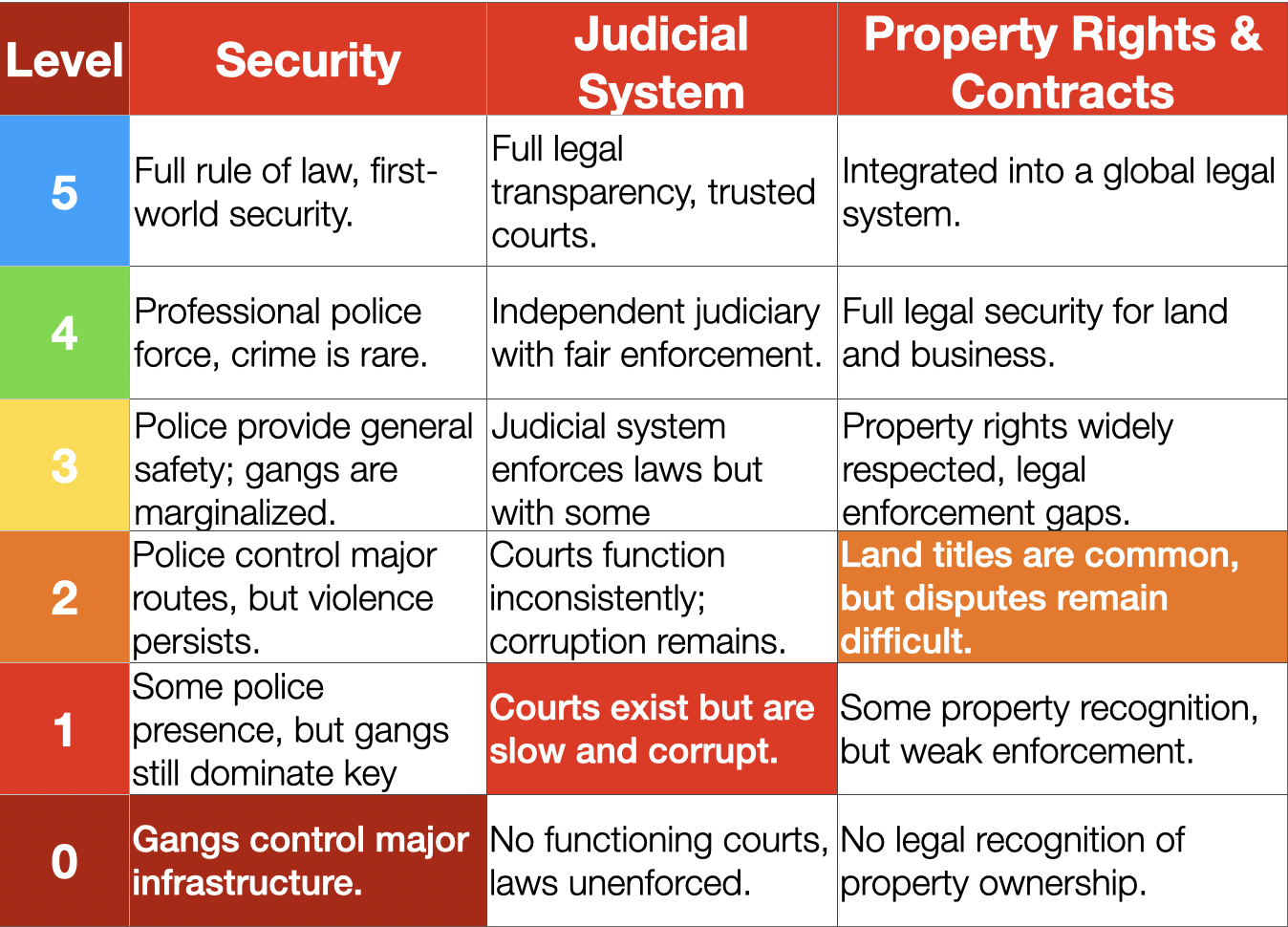
The tables below break Haiti’s development into five major work streams, each with its own levels of progress. These levels define the transition from collapse to basic functionality, then toward long-term stability and first-world standards.
Each work stream contains sub-work streams, allowing for a detailed, measurable approach rather than overly broad generalizations. Importantly, Haiti does not have to reach Level 5 in every category before real improvements are felt—progress in key areas can create catalysts for change in others.
Please consider this a work in progress—meant to fuel discussion, not end it.The Five Work Streams
Rule of Law – Security, judicial system, property rights
Governance – Elections, public administration, decentralization
Economy – Formal vs. informal economy, investment, workforce development
Social / Human Rights / Health – Human rights, healthcare, education
Ecology – Environmental protection, deforestation, waste management
Each work stream is measured on a 0-5 scale, where:
0 = Complete breakdown (no institutions, total instability)
1 = Initial stability (some structure, but still fragile)
2 = Basic functionality (services exist but are weak)
3 = Institutional strength (systems work but with inefficiencies)
4 = Long-term stability (strong, consistent performance)
5 = First-world standard (fully developed and self-sustaining)
Where is Haiti Today?
Haiti is at different stages in each work stream. Some areas have reached level 2 or 3, while many remain in a state of collapse (0-1). The tables below provide a detailed breakdown of Haiti’s position within each category, offering a clear, structured path forward rather than reactive crisis management.